You can effectively teach puppy sit drop stay by using high-value treats to lure them into each position while offering immediate verbal praise. Master the sit first by moving a treat over their head; then progress to the drop by luring the treat to the floor, and finish by rewarding the stay as you gradually increase duration and distance.
Bringing a new puppy home often feels like managing a whirlwind of energy; it is particularly frustrating when they jump on guests or refuse to settle down. While this chaotic phase is normal, establishing a reliable foundation of obedience is the only way to ensure your dog grows into a calm and well adjusted companion. Mastering the sit, drop, and stay sequence provides the essential structure needed for everyday safety and long term focus. In this comprehensive guide, we will break down the precise mechanics of lure training to achieve a perfect sit. You will learn how to transition into a relaxed drop and how to build the duration required for a dependable stay. We also share expert strategies for troubleshooting common mistakes and phasing out food rewards, ensuring your puppy remains responsive even when distractions arise.
Why Sit, Drop, and Stay are the Foundation of Puppy Training
Building a functional vocabulary with your new companion starts with three core behaviors. In Australia, we view these commands not as optional tricks, but as essential safety tools for navigating our modern environment. A reliable 'sit' prevents your puppy from charging through the front door or jumping on visitors. A solid 'stay' provides a critical safety net near busy roads or when loading into the car for a trip to the beach. For those who enjoy the local social scene, a 'drop' ensures your puppy can settle quietly under the table at a dog-friendly cafe while you finish your coffee.
It is important to note the Australian preference for the word 'drop' rather than 'down'. Using 'drop' to describe the lying position prevents confusion with the command 'off', which is typically used to tell a dog to remove their paws from furniture or people. This distinction is a hallmark of the clear communication we advocate for in our complete online puppy training course. By establishing these boundaries early, you are not just teaching obedience; you are building a bond based on mutual understanding. If you encounter specific challenges while you teach puppy sit drop stay sequences, you can always contact our training experts for tailored advice.
Preparation: What You Need Before You Start
Success begins long before you give your first command. Many owners ask what age to teach puppy to sit, and the answer is as soon as they arrive home, typically around eight weeks of age. Early training leverages their natural curiosity and sets a foundation for lifelong learning during those critical developmental weeks.
Before you begin, gather high-value rewards to keep your puppy engaged. In Australia, small pieces of dried liver or tiny cubes of cheddar cheese are excellent choices because they are aromatic and highly motivating. You also need a quiet indoor environment. Attempting to teach puppy sit drop stay sequences at a local park is a common mistake; the smells and sounds of the outdoors are far too distracting for a beginner. Start in a familiar room with minimal foot traffic where your puppy can focus entirely on you.
Keep your mindset focused on brevity and patience. Puppies have incredibly short attention spans, so limit your training sessions to just three to five minutes. It is far more effective to conduct several short bursts throughout the day than one long, exhausting lesson. If you feel yourself becoming frustrated, it is best to end the session early. Training should be a positive experience that strengthens your connection, a core principle we explore in our complete online puppy training course.
How to Teach Your Puppy to Sit with Lure Training
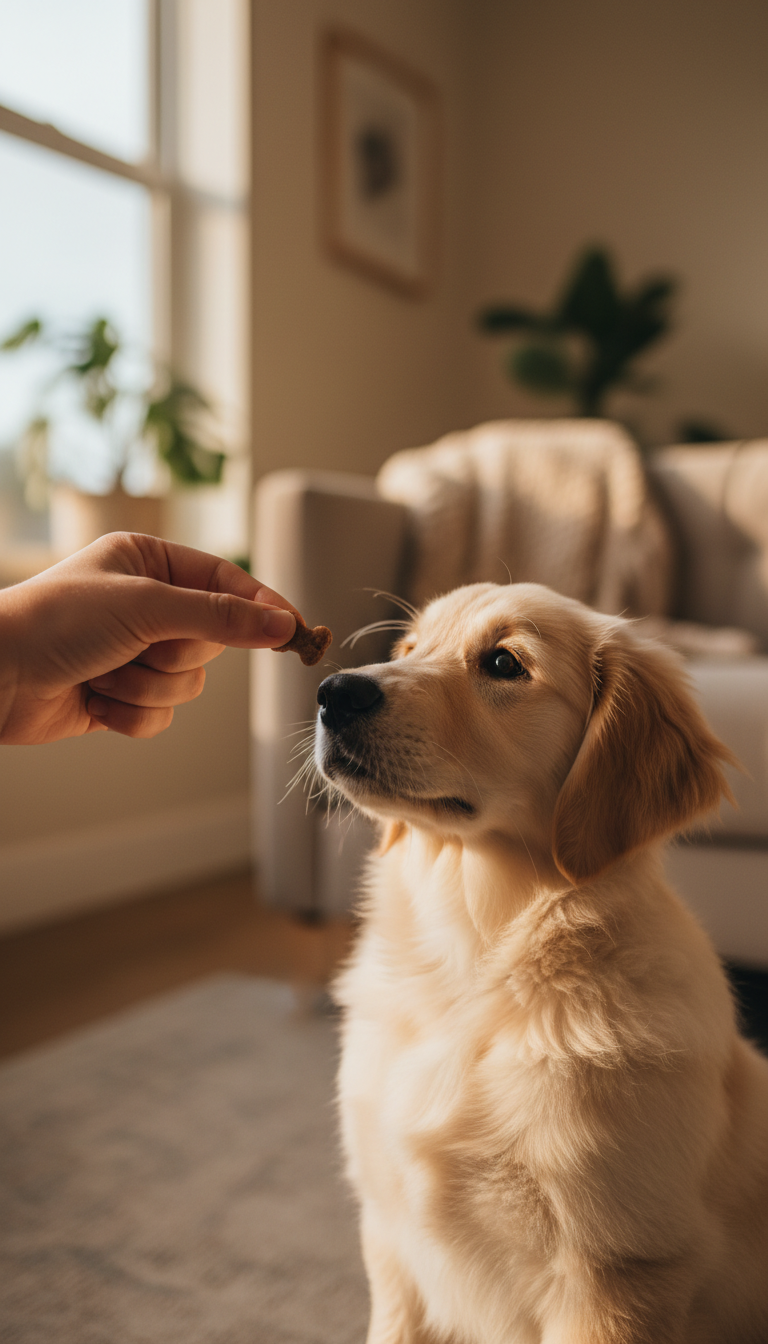
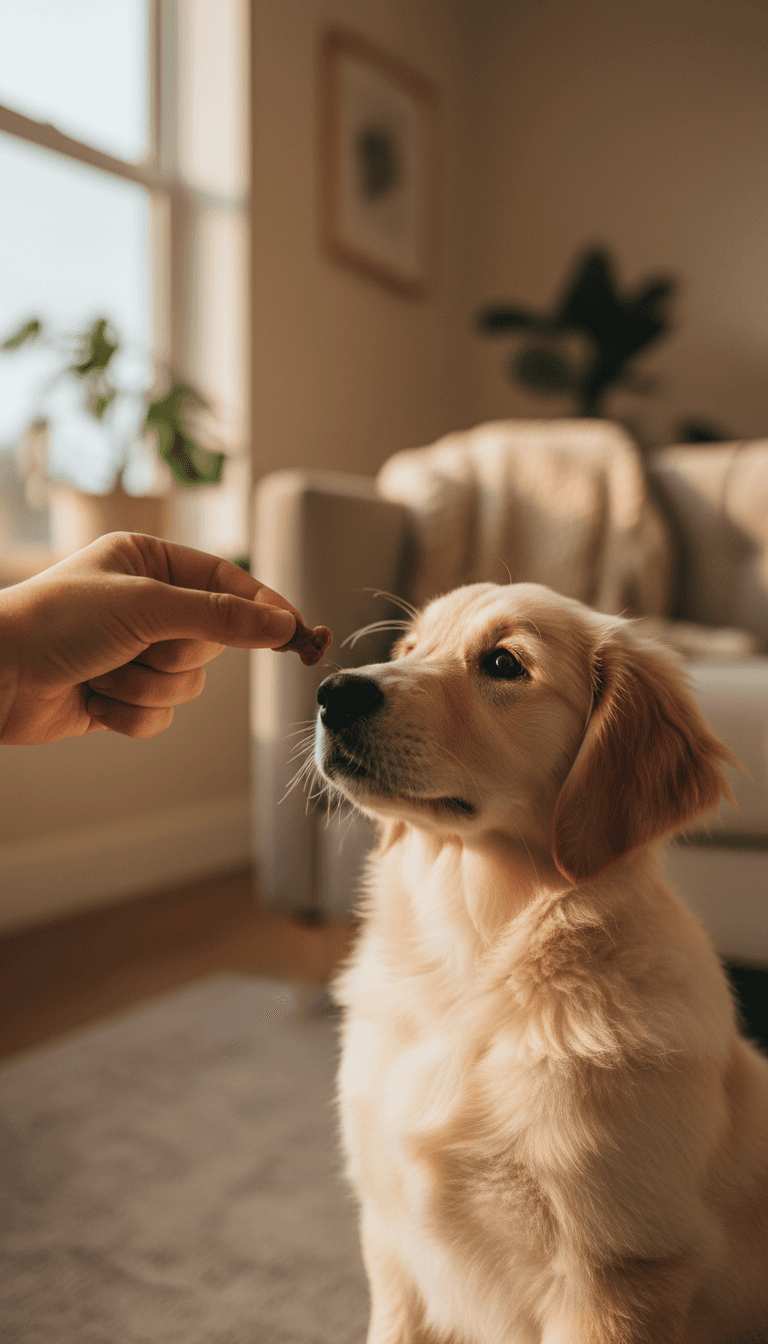
Lure training is the most effective way to communicate what you want without using physical force. To begin, ensure your puppy is in a standing position. Hold a small, aromatic treat directly in front of their nose to capture their attention. Once they are focused, slowly move your hand in an upward arc over their head, moving toward their tail. As the puppy's nose follows the treat upward, their center of gravity shifts; their head goes up, and their bottom naturally goes down to the floor.
The moment their rear touches the ground, provide the reward and verbal praise. It is vital that you never push your puppy's bottom down with your hand. Physical pressure often triggers an opposition reflex, where the puppy resists by pushing back against you, and it can even cause physical discomfort. By using the arc lure, you allow the puppy to discover the movement independently, which builds much stronger muscle memory. If your puppy jumps up instead of sitting, you are likely holding the treat too high; keep it closer to their muzzle as you draw the arc.
Only introduce the verbal cue once the physical behavior is predictable. If you repeat the word while the puppy is still confused, the command loses its value. Once they follow your hand signal reliably, you can start saying "sit" just as they begin the movement. To ensure they do not become treat dependent, begin to phase out the food through intermittent reinforcement. This involves rewarding only the best or quickest responses, a technique we cover in detail within our complete online puppy training course. If your puppy consistently backs away instead of lowering their rear, contact our training experts for help with your luring technique.
Teaching the Drop: Moving from Sit to the Floor
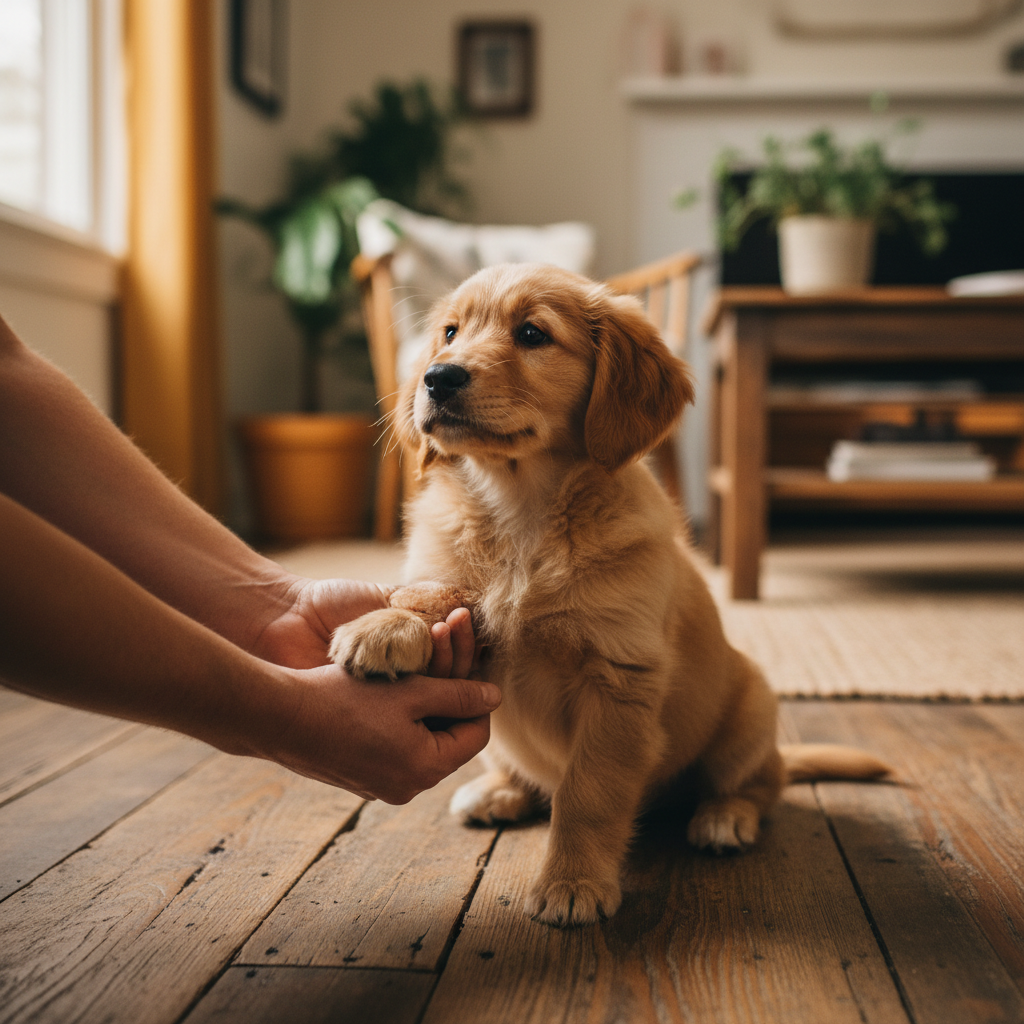
Once your puppy has mastered the sit, you can progress to the 'drop'. This position is particularly useful for encouraging calmness in public spaces or keeping your pet settled at home. To begin, ask your puppy to sit. Hold a high-value treat close to their nose, then move your hand straight down to the floor, aiming for the space between their front paws. Once your hand reaches the ground, slowly pull the treat forward along the floor away from the puppy, effectively tracing an 'L' shape.
Success is achieved the moment your puppy's elbows touch the floor. Immediately mark this behavior with praise and the treat. It is common for puppies to stand up or pop their rear into the air when the lure moves forward. If this occurs, you are likely moving the treat too quickly or too far away from their muzzle. Keep your hand low and move at a snail’s pace to keep their nose glued to the reward. Ensure you are not pulling the treat upward, which encourages them to stand back up.
If your puppy is struggling to grasp the lure, try the 'under the leg' trick. Sit on the floor with one leg bent to create a small, low tunnel. Lure the puppy with a treat to crawl under your leg; as they duck their head and body to clear the 'tunnel', they will naturally drop into the correct position. This physical boundary often helps them understand the movement more clearly than a free-space lure. Mastering these transitions is a key component of our complete online puppy training course. If your puppy remains hesitant to lower their chest to the ground, you can contact our training experts for alternative shaping strategies. This foundation is essential as you continue to teach puppy sit drop stay behaviors that ensure a well-behaved companion.
The Stay Command: Building Duration and Reliability
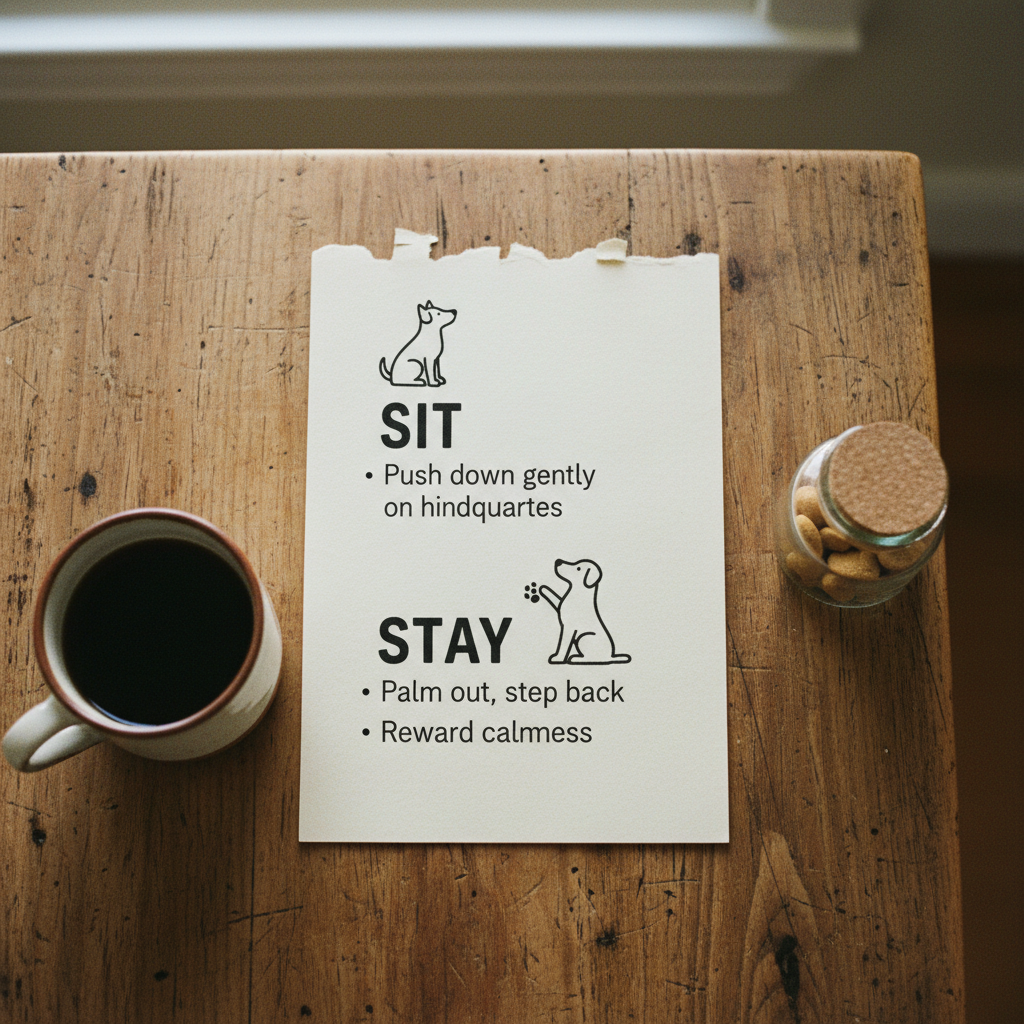
Mastering the stay command represents a significant shift in your puppy's development. While sitting or dropping are active physical movements, staying is an exercise in impulse control and concentration. At its core, a 'stay' is a contract between you and your puppy; it means they must remain in their current position until you provide a specific release word. Common release words include 'Free' or 'Okay'. It is vital to choose one word and use it consistently to signal that the task is complete.
To effectively teach puppy sit drop stay behaviors, we use the Three Ds: Duration, Distance, and Distraction. These should be introduced one at a time to avoid overwhelming your puppy.
Training Pillar | Description | Initial Goal |
|---|---|---|
Duration | How long the puppy holds the position. | 2 to 5 seconds |
Distance | How far you move away from the puppy. | One small step |
Distraction | Environmental changes like noises or movement. | A quiet hallway |
Begin with your puppy in a sit or drop. Use a clear hand signal, a flat palm facing the puppy like a 'Stop Sign', and say the word 'stay'. Initially, your goal is duration only. Stand perfectly still for just two seconds, then give your release word and a treat. Most owners fail because they try to walk across the room too quickly. If you increase the distance before the duration is rock solid, the puppy will likely follow you.
If your puppy breaks the stay before you give the release word, do not offer a treat. Calmly guide them back to the exact spot where they were and try again, but make the task easier by reducing the time or distance. Building this reliability is a central focus of our complete online puppy training course. If you find your puppy consistently breaks position as soon as you turn your back, you can contact our training experts for help refining your body language and timing.
How to Train Your Puppy to Sit and Stay Without Treats
Owners often worry about becoming a human vending machine, fearing their dog will only listen when food is visible. The transition away from food starts by fading the lure. Begin using the same hand signals you developed during luring, but with an empty hand. Keep your treats in a pocket or pouch and only produce the reward after the puppy has completed the desired action. This shift teaches your puppy that the hand signal is the instruction, while the food is a consequence of their success.
To effectively teach puppy sit drop stay sequences without food, you can incorporate life rewards. These are functional motivators that exist in your daily routine. For example, ask for a sit before the back door opens for a walk or require a stay before you place their dinner bowl on the floor. Using a favorite toy for a quick game of tug or offering genuine physical praise are also excellent alternatives to treats. This approach builds a puppy that is motivated by your relationship and the environment. For advanced techniques on fading out food, visit our complete online puppy training course or contact our training experts for specific advice.
Troubleshooting Common Puppy Training Mistakes
Transitioning to real-world application often reveals technical errors that stall progress. One frequent mistake is repeating commands like "Sit, sit, sit." This teaches your puppy that the first few cues are optional. Give the cue once. If they do not respond, go back to a physical lure rather than nagging.
Physical mechanics are also vital. Holding the treat too high while luring causes your puppy to jump rather than sitting. Keep the lure inches from their muzzle to guide the head up and the bottom down. Furthermore, avoid introducing distractions too early. Attempting to teach puppy sit drop stay behaviors in a busy park before they are perfected at home leads to unnecessary frustration.
Finally, do not forget the release word. Without a clear "Free" or "Okay," your puppy will eventually release themselves, which undermines their impulse control. At Online Puppy School, we view these hurdles as a need for more clear communication and smaller steps. If you encounter these issues, contact our training experts or revisit our complete online puppy training course.